The eviction process in Washington State requires landlords to follow specific legal procedures under RCW 59.12 and RCW 59.18. Self-help evictions, including changing locks, shutting off utilities, or removing tenant belongings, are illegal.
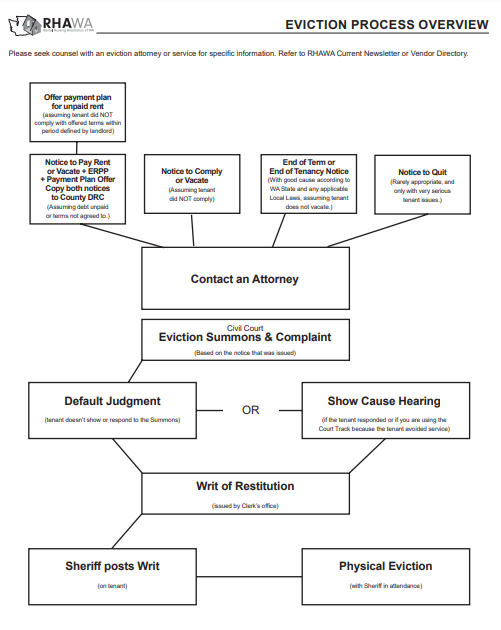
The process follows a clear sequence:
- Written notice. 14 days for non-payment, 10 days for lease violations.
- Unlawful detainer action. If the tenant does not comply, you file in superior court.
- Resolution. Uncontested non-payment cases often resolve in 3 to 8 weeks; contested cases can run several months.
Statewide just cause rules under RCW 59.18.650 limit when a tenancy may be ended at all.
This post is part of our Washington lease compliance series. It is general information, not legal advice. Eviction is the one process where we always involve specialized counsel, and we recommend you do the same.
Is Eviction the Best Remedy for You?
Since 2019, evicting a tenant for non-payment of rent has become a far more regulated process. Washington encourages landlords and tenants to pursue payment plans and financial assistance programs before filing, and courts expect to see that effort.
Put your rent collection process in writing before you ever need it. A written Rent Collection Policy and Procedures document gives you a consistent, defensible record of every step you took.
If your tenant is uncooperative or refuses to engage, eviction may still be the fastest way to resolve the situation. In cases involving other lease violations, a properly served notice often leads to the tenant correcting the issue or vacating voluntarily, without a courtroom.
Before You File: Alternatives That Usually Cost Less
Most non-payment situations resolve without a judge. Exhaust these first:
- A written payment plan with dates and amounts, signed by both parties. It preserves the tenancy and your income stream.
- Rental assistance. County programs and nonprofits pay real arrears every day; a tenant who applies in good faith is usually worth the wait, and courts look favorably on owners who cooperated.
- A negotiated move-out. A clear agreement on a date, condition, and key return often costs less than a contested case, in both money and months.
An eviction filing is public record and affects the tenant's housing prospects for years. Use it as the last tool, not the first. That order of operations is both the humane choice and the financially sound one.
Eviction Process Overview
Flow chart provided by Rental Housing Association of Washington.
Know What the Tenant Can Raise: Defenses and Resources
Understanding the tenant's side of an unlawful detainer case is not a courtesy; it is how you avoid losing one. Tenants in Washington commonly raise:
- Procedural defects. A notice with the wrong period, missing required language, or improper service can get a case dismissed, and you start over from day one. This is the most common way owners lose.
- Just cause. Under RCW 59.18.650, most tenancies can only be ended for a listed cause, and Seattle layers stricter rules on top.
- Habitability and retaliation. Open repair requests, code complaints, or a recent rent increase near the filing date will be examined.
- Right to counsel. Under RCW 59.18.640, low-income tenants are entitled to a court-appointed attorney in eviction proceedings. Assume the other side will be represented, because they usually are.
Tenants also have access to resources including Washington Law Help, the 2-1-1 referral line, and county legal aid programs.
None of this is bad news for a prepared owner. If your notice is correct, your documentation is complete, and your cause is real, these protections mostly punish sloppy filings, not legitimate ones.
Should I Hire an Eviction Attorney?
Yes. Sagareus always engages an eviction-specialized attorney to formalize and streamline the process. By hiring specialists, we ensure every step is completed correctly and fully documented, and the timeline is adhered to perfectly. One small misstep in the process can mean starting over completely.
We engage LT Services, who serve King, Pierce and Snohomish Counties at a set rate per service.
What Does an Eviction Cost?
It varies with the county and how far the case goes. For an uncontested non-payment case, attorney fees in Washington often land around $1,500. Court filing fees, service costs, and sheriff fees add to that, and a contested case can push the total to several times more.
Budget for the range, then work the alternatives above so you never spend it.
How Long Does an Eviction Take?
Uncontested non-payment cases are often resolved within 3 to 8 weeks from notice to resolution, and many settle as soon as the tenant receives a properly served notice. If the case is contested or proceeds all the way to a sheriff-enforced removal, plan for 3 to 6 months. Most cases settle before that stage.
Do You Have to Go to Court?
If you hire an attorney, they represent you and your day-to-day involvement is minimal. If the tenant contests the eviction and a show cause hearing is set, you or your property manager attends with your attorney. That hearing is where the tenant presents their case and the court decides whether the eviction proceeds.
Can You Serve Your Own Notice?
Yes, Washington law allows landlords to serve their own eviction notices, following the service rules in RCW 59.12.040. But this is the single most common place evictions fail: a notice that is incorrectly served, mis-counted, or improperly formatted gets the case dismissed. Use a professional service or counsel for anything you are not certain about.
Should You Accept Payment from Your Tenant?
Once you have begun the eviction process, be careful about accepting payments. In most cases, accepting payment halts the eviction. If you accept partial payment today, then your tenant defaults again, the process starts over.
You are not required to accept partial payments. If you issued a Pay or Vacate notice, you must accept full payment up until the sheriff removes the tenant. After a Notice to Comply or Vacate or a Termination of Tenancy notice, you are no longer required to accept payment.
Conclusion
Understanding the eviction process in Washington is key to a smooth resolution when a tenancy fails. Work the alternatives first, serve flawless notices, document everything, and use specialized counsel when you file.
Most of all, prevent the situation: nearly every eviction we see traces back to a screening or documentation shortcut taken months earlier.
How Sagareus Handles Eviction
Lead with empathy, act on boundaries, and treat filing as the last resort. Across 800+ units, the resolutions that recover the most money and keep a tenancy intact happen before anyone files. So we work the problem early and honestly:
- One real chance to recover. A one-time payment plan, plus coordination of any rental assistance funds, to clear the balance and keep the home.
- A clear line if the plan breaks. From there it is pay in full, a mutual move-out, or we begin the lawful eviction process. The help does not loop forever.
- Specialized counsel when we file. We file through experienced eviction attorneys, assigned by county, and a manager reviews the full file first, the ledger, the notices, and the collection history, before anything goes out.
The boundary is not coldness; it is protection for both sides. Dragging out a default only buries the resident in a debt they cannot repay while your unit earns nothing. A clean, early exit is the kinder outcome. And the best eviction is still the one prevented at screening, months before.